Maine State Highway System
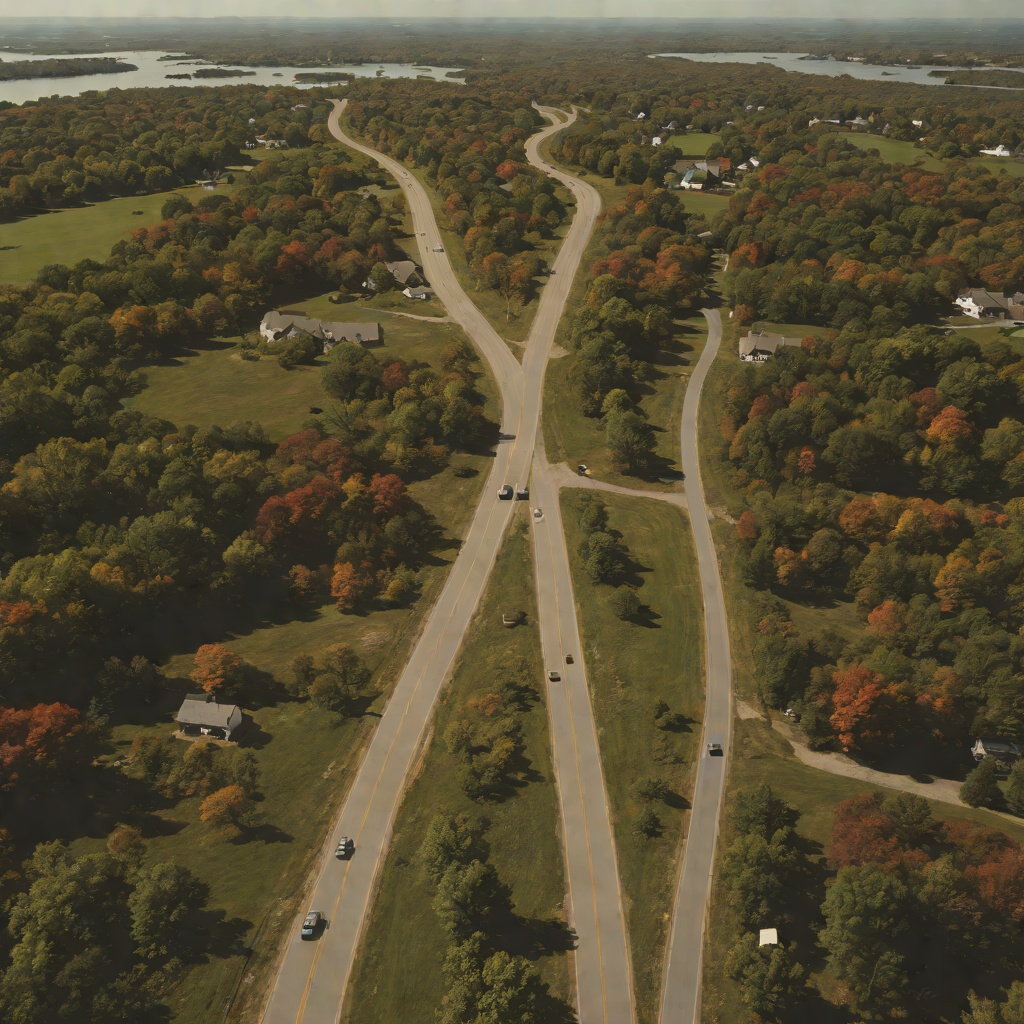
The Long WalkThe Maine Turnpike is a recurring road landmark in the Long Walk, but its decisive importance is not merely geographic. It measures the walkers’ progress toward Oldtown, separates them from traffic and spectators, and converts their exhaustion into a sequence of public scenes. Signs announcing the remaining distance promise orientation while the turnpike’s ramps, embankments, lamps, and crowds make the route feel increasingly like an engineered corridor from which the walkers cannot freely depart.
Definition and Route Function
The Maine Turnpike appears first as a future threshold. A green sign tells the walkers that the turnpike lies forty-four miles ahead, and Ray Garraty immediately translates that information into a destination: forty-four miles to Oldtown. The sign gives the journey a concrete scale, yet it also turns distance into a burden that can be counted, anticipated, and feared. Oldtown is not simply a town on the route; it is the next major marker by which the walkers judge whether their bodies can continue.
Later, at a road junction lit by a huge luminous arrow and accompanied by a brass band, the route changes. A new Maine Turnpike sign reduces the remaining distance to Oldtown to sixteen miles. This sudden revision produces a tentative feeling of excitement and pride in Garraty because he knows the road beyond Oldtown so well that he could trace it on his palm. The turnpike therefore functions as a hinge between uncertainty and familiarity: it narrows the immediate distance while confirming that the walkers are entering a route Garraty has already imagined and mentally mapped.
Infrastructure and Controlled Movement
The turnpike’s physical design reinforces the Event’s control over movement. Near Oldtown, the walkers travel parallel to it while Garraty sees the steep embankment and the pale glow of arc-sodium lamps above. Half a mile ahead, an entrance ramp splits off and climbs toward the road. The turnpike is visible but not freely available; its elevated surface and divided access dramatize the difference between ordinary transportation and the walkers’ prescribed path. They are close to a major public highway, yet their own movement remains governed by the rules of the Long Walk.
That controlled geography becomes especially stark when the walkers reach a crowded section near Freeport. Garraty drifts toward the right until the crowd’s grasping hands are only inches away. One long arm actually catches at his shirt, and soldiers point their guns at him in case he tries to vanish into the human surge. The road thus has two boundaries at once: the infrastructure of the highway and the living barrier formed by spectators and armed personnel. Garraty cannot turn toward either traffic or freedom. The turnpike is a public route transformed into a channel for state-supervised exposure.
Media Spectacle Along the Road
The turnpike belongs to a landscape in which the Long Walk is continuously packaged for observation. Earlier, in Caribou, the walkers pass through city limits into a battery of television lights, while a newspaperman in a three-piece suit pushes a long-reach microphone toward them and technicians unreel electric cable behind him. When the cable runs out, the reporter retreats toward the mobile unit through the tangles. The crowd has gathered partly because of the television crew, showing that the event attracts spectators not only through direct presence but also through the machinery of broadcast.
The same process appears in the signs and performances surrounding the route. A girl holds up a Magic Marker sign identifying Garraty as “GO-GO-GARRATY NUMBER 47 We Love You Ray ‘Maine’s Own.’” The nickname gives him a marketable public identity, turning a local boy into a regional symbol. At larger gatherings, State Police hold back deep ranks of spectators with bright orange nylon ropes, while flashbulbs burst and a child waves a toy glider and an autograph book. The walkers’ private pain is made available as a civic entertainment, organized by signs, cameras, lights, restraints, and the expectation that the participants will remain visible.
Crowds, Violence, and the Road’s Meaning
The turnpike’s public setting intensifies the contrast between cheerful spectatorship and bodily destruction. In the hundred-mile crowd, the cheering is described as surf hammering rocks; State Police restrain the people while the walkers remain exposed in the center of the spectacle. Near Oldtown, their passage through the town becomes a ticker-tape parade in miniature: arc-sodium lamps turn night into a shadowless orange day, and confetti, newspaper, telephone-book fragments, and toilet paper descend from upper windows. The road appears festive precisely when the walkers are most vulnerable, making celebration and mortality occupy the same visual frame.
The spectacle reaches a delirious height after Augusta, when enormous purple-white spotlights cut through the air and the Major drives away in his jeep, holding a rigid salute. The remaining thirty-seven walkers cheer despite their exhaustion, and Garraty feels a stabbing pain in his chest while recognizing that he is pushing toward disaster. The road has become a ritualized arena in which official ceremony, mass emotion, and physical danger reinforce one another. When Milligan collapses and is killed, the cheering stops. His death breaks the collective trance, revealing the violence that the crowd’s excitement had temporarily concealed.
Progress, Memory, and Entrapment
The Maine Turnpike repeatedly promises that the journey is becoming manageable: forty-four miles becomes sixteen, and the visible entrance ramp suggests that the walkers are approaching a known stage. Yet each measurement also tightens the pressure. Distance is not freedom but an obligation to continue. The closer Garraty comes to familiar places, the more sharply he feels the conflict between personal memory and the public route imposed upon him.
At Freeport, the turnpike carries him toward Woolman’s and the possibility of seeing his mother or Jan, but the crowd and soldiers make recognition nearly impossible. He can see the large brown Woolman’s sign, yet not the faces he hopes to find. His disappointment becomes so overwhelming that he wants to stop before reaching the destination. The road’s apparent familiarity therefore turns against him: a route associated with home and ordinary life becomes the place where home may be present but inaccessible. In the Long Walk, the Maine Turnpike is consequently both a map of progress and a mechanism of entrapment, guiding the walkers forward while making every approach to safety, intimacy, or escape more painfully visible.